
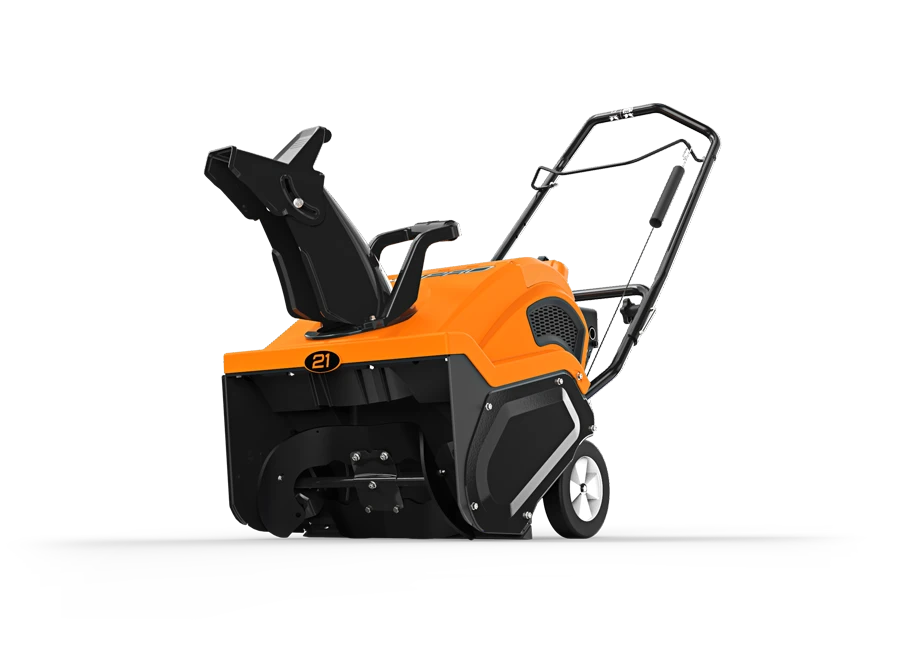
Choose a snow-blower width that fits both the clearing job and the route to it. A 28-inch clearing width may reduce passes across an open area, while a smaller machine may be easier to accommodate through a gate or in storage. Compare the whole machine’s dimensions as well as its working width.
Measure three different things
- The clearing area: length and width of each driveway section or path.
- The tightest opening: gates, doors and gaps between fixed obstacles.
- The storage footprint: space available with room to approach and operate the handles.
Do not substitute the advertised clearing width for overall width. Chute position, handles and other parts may affect the space required. Confirm the manufacturer’s actual dimensions for the exact model.
A simple pass-count example
Suppose a rectangular strip is 240 inches wide and you clear along its length. Ignoring overlap, a 24-inch width requires 240 divided by 24 = 10 passes. A 28-inch width requires 240 divided by 28 = 8.57, rounded up to 9 passes. That is a geometric comparison, not a prediction of clearing time.
Real work includes overlap, turning, changing speed, repositioning the chute and working around obstacles. Wet snow or a dense plow bank can change the pace. Do not turn a one-pass difference into an unsupported promise about minutes saved.
Build a short comparison sheet
- Candidate model and full model number.
- Clearing width and overall dimensions.
- Surface suitability and intake height.
- Drive and steering arrangement.
- Machine weight and storage access.
- Starting method and maintenance requirements.
- Total delivered price and any required assembly.
Ariens’ selection guidance considers snowfall, clearing area, surface and slope together. That is a better starting point than engine size or width alone. If two machines differ in several features, record those differences before attributing the whole price gap to four extra inches.
What if the bigger model barely fits?
A nominal match leaves little allowance for maneuvering. Measure the usable opening, including hinges and other obstructions, and confirm handling space with the seller or manufacturer. Avoid buying from an estimate such as “the shed is about three feet wide.”
First decide on single-stage or two-stage suitability, then compare tracks and wheels where traction is a concern. Use those decisions to narrow the equipment catalog, and review shipping arrangements before ordering.
Sources and further reading
 Start with the right reference
 Plan the arrival
Always confirm the exact model, part number, condition and included components on the product listing. For a compatibility question, contact TorqueHarbor before ordering.